 eveofdarkness.org
Designing three-realm games for lasting play
I played Dark Age of Camelot in its early years 2001+, mostly in Midgard, with some time in Albion and Hibernia. A lot of it I played with my young son. We both quit around the time of Trials of Atlantis. Long ago I tried a few freeshards, but I never really came back. Since then I've watched the same story play out from the outside, on Mythic's servers and on the shards that came after.
DAoC launched in October 2001 with a simple promise: three realms, one war. At its peak it had about 250,000 subscribers. That's small next to what came later, but the war was the game.
My main was a dual-wielding Midgard Shadowblade, Plooker (MLF) in a guild called Norwegian Wood. I got him to 50 the hard way. Nobody power-levelled me, and I did most of it solo. Later I got a buff bot on a second account running on a second computer. Then the nerfs came, before I'd had a real chance to take him into the frontier: to left-hand axes, to poisons, to Midgard's Shadowblades. And realm points turned out to be the next grind, one I couldn't do solo. I tried a Smite Cleric in Albion. Nerfed too. It teaches you a lesson: stop putting a lot of time into something that can be taken away.
So I went back to PvE, exploring the other realms and classes, and waited for a game worth leaving for.
I wasn't alone. In 2003, DAoC players told Nick Yee the developers kept "nerfing this group of players or that group". Mark Jacobs, who led Mythic, later described "the constant cycle of improve and nerf, improve and nerf," and added, "We did it with Dark Age of Camelot." Back then, I saw a struggling company swinging from nerf to change to nerf, trying to get it right and not managing to. I have more sympathy now. I know more about what goes into balance, how a company's business needs pull against gameplay, and how a change that helps this month can hurt next year.
Then there was the content. In my view, the expansions after Shrouded Isles started DAoC's assured, long decline. Trials of Atlantis, in October 2003, added artifacts and Master Levels: power earned by grinding PvE, which RvR players had to chase to stay competitive. A history of the game later called it "reviled by both players and (believe it or not) members of the developer team". In 2005 Mythic opened Classic servers without it, "based on player feedback", and Jacobs later said "we made some poor design decisions". Subscriber numbers held up for a while, and World of Warcraft arrived at the end of 2004, so nobody can cleanly separate the causes. What I saw was less fighting in the frontier.
Everyone was looking for a reason to leave. Before World of Warcraft came along and took nearly everyone, the talk was of Shadowbane. My guild left and jumped to Shadowbane or somewhere, and I was left on my own. Later the talk was of Warhammer Online, and later still Crowfall. We didn't call them "DAoC killers." We just wanted relief from the Mythic hammer coming down on a game that was dying for all of us. The new games never quite gave it to us. All three come up again below.
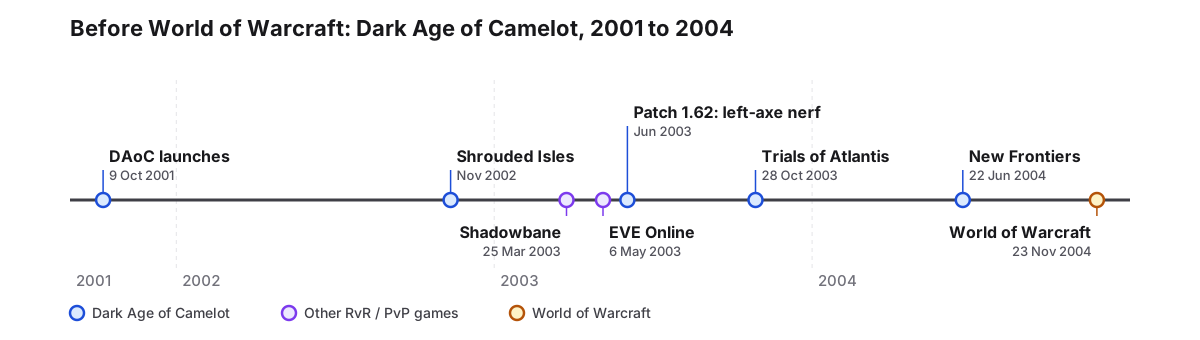
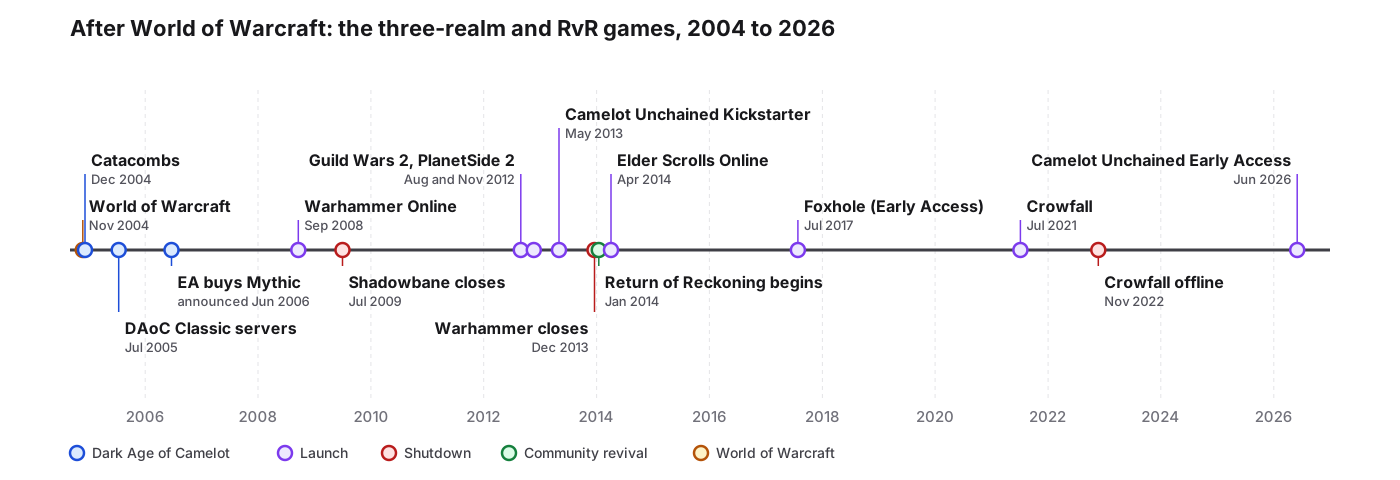
Not every expansion was a mistake for everyone, though. A three-realm game also holds crafters, PvE players, explorers, and people without the hours for a warband. They welcomed housing and new dungeons. The trouble came when content they enjoyed held power the frontier crowd needed.
The freeshards replay the story faster. A shard launches, its population slowly falls, and its staff or players move on to the next one; our family tree of DAoC servers dates a good number of them.
Then there is Camelot Unchained, Mark Jacobs' return to three realms. It gave hope to the growing ex-DAoC community that was nostalgic for an old neighborhood that no longer existed! It was announced in 2013 with the promise that "RvR isn't the endgame — it's the only game", funded on Kickstarter that spring, and aimed at late 2015. What followed: an engine built from scratch, which the studio later renamed itself after and set out to sell; a second game announced before the first was finished, with backers asking for refunds; and, in January 2025, layoffs of about 40% of the staff. Thirteen years after the Kickstarter, CU is in Early Access, with servers open mainly at weekends. In my opinion, that's very poor leadership and bad judgment with other people's money. The studio didn't need its own engine, and backers didn't pay for one. That vanity project was the largest red flag in a series of almost-forgivable delays. Nothing here is likely illegal, but I think it's definitely unethical: the kind of conduct most people would recognise as bad faith. Yes, I'm still angry about it, and so are many backers.
But, looking at the DAoC decline and the community of ex-players that it left, I kept coming back to seeing this as a single problem with four parts:
- Player Investment: what players put into their characters.
- Game Balance: whether changes protect that investment or wreck it.
- Game Mechanisms: the rules that make the war work.
- Service and Management: how much the people running the game have to keep building to keep it alive.
Mythic, Shadowbane, Planetside, Crowfall, the CU team, and every shard team have been working on that same set of challenges. The volume of recent AI-enabled, DAoC-centric, game development / projects has pushed me into the psychology behind it, and then to cast a wider net: what other three-faction games tried, which failed, and which half-succeeded.
TL;DR
- Make small groups matter. Supply lines that a few players can cut mean the zerg can't do everything at once. Let crafters at home feed the war too.
- Size the frontier to the population. Fewer objectives when it's quiet, more when it's busy, with different thresholds for opening and closing. PlanetSide 2 did this.
- Losing should leave something behind. Keep the history, cap the carry-over, and never reward the winner with a snowball.
- Give the two weaker realms a reason to team up, with rules and an end date. Weaker parties ganging up on the leader is old coalition theory, not just a film trope. Make it a bounded operation with a clear trigger, not a permanent 2v1.
- Building is cheap now; running isn't. Crowfall's team said the hardest part was "the development effort required to build new campaigns and keep the game running daily." Count staff hours, not just player hours.
- Keep frontier power out of PvE. That was Trials of Atlantis's mistake. Crafters, explorers and PvE players deserve content, but RvR players shouldn't have to grind it to compete.
- Change the situation, not the character. Every nerf teaches players to stop investing. Rotate objectives, maps and stakes; leave builds alone unless something is truly broken.
- Start with one zone and measure two things: whether players come back after losing, and how many hours staff spend keeping it running.
So, what follows is a design hypothesis to test, not a formula for guaranteed balance. Other games show the parts working; none of them shows this particular combination working.
Three realms are a chance, not a guarantee
A third realm lets you hit an enemy who is busy elsewhere, take an open flank, or team up against whoever is winning. It doesn't make anyone do it. If the second-strongest realm earns easier rewards by farming the weakest, you get a dogpile. If the weakest stops showing up, the three-way war turns into a lopsided two-way one.
"Balance" also means several different things. Realms can have equal populations and still differ sharply in organisation, time-zone coverage, character progression, or how many people are at one spot at one time. A fair class matchup doesn't make forty against eight fair. And extra rewards for the small realm can't fix an ability nobody can counter.
DAoC has tried a structural fix. In January 2020 it brought back bonus realm points for underpopulated realms, recalculated every 15 minutes from the number of players in the frontier. That's an automatic incentive. Whether it fixed the imbalance is a separate question.
So the goal is wider than equal headcounts or equal wins: every realm keeps choices that matter, players find fights worth having, and a win makes sense even to the people who lost it.
What keeps people playing
Ryan, Rigby and Przybylski tied game enjoyment to three needs: autonomy, competence and relatedness. For RvR they become three questions. Can I choose something worth doing? Can my decisions and skill change the result? Do I have a place among the people I play with? That's what happened to me: the nerfs took the competence, the grind took the choice, and when my guild left, it took the people.
Nick Yee surveyed 3,000 MMO players, recruited partly through DAoC communities, and found three overlapping motives: achievement, social and immersion. A war built only around kill counts and optimised eight-person groups serves the first and shortchanges the other two. Scouting, hauling, breaking up an operation and covering a retreat are other ways to matter.
Ducheneaut and colleagues watched World of Warcraft players and found many of them "alone together": they like playing among others without grouping all the time. That argues for useful ways in for occasional and solo players, alongside the coordinated objectives, not instead of them.
Not everyone in a three-realm game came for the war. DAoC has always had crafters, PvE players, explorers, and people who simply don't have the hours to keep a group together or a guild relationship going. Frontier fighting rewards exactly those things. For these players, housing, new dungeons and quality-of-life changes aren't a distraction from RvR they would otherwise have joined. They're the reason to stay subscribed. And they keep the realm going: crafters make the armour, weapons and siege engines the frontier runs on. A realm war that only rewards the eight-person group loses the people who supply it.
Two things follow. Players may take a lost campaign better when they can point to something they got done and something they'd try differently. And the rules have to feel reliable. Rewriting a class's role again and again hits exactly the competence and investment those studies describe. Good structure takes pressure off reactive balance patches. It doesn't replace fixing a class that is actually broken.
What other games tried
DAoC: fighting for access
Darkness Falls ties the frontier war to entry to a dungeon everyone wants. When another realm takes the portals, players already inside can stay until they leave or /release. That handover creates fights a simple ownership flag never would.
The idea worth keeping: fighting over there changes what you can do over here. A new territory could stretch that into gathering, hauling or building. The catch is that exclusive access also rewards the realm that is already winning, so a prize like that needs ways back in for everyone else.
PlanetSide 2: territory that fits the population
PlanetSide 2 is the closest precedent. Its 2018 unstable warpgates kept most of a newly opened continent uncapturable until enough players arrived. In 2021 the developers planned to run only the small Koltyr continent when population was low, and to fire an alert at high population to give the crowd a goal.
The lesson: match the number of live objectives to the number of players. The risk: squeezing everyone together makes a meat grinder. A smaller map still needs other routes, ways out, and things to do away from the biggest fight.
Guild Wars 2: averages hide the bad hours
Guild Wars 2 reshuffled its World vs World teams instead. In July 2024 ArenaNet reported that most teams looked similar on player hours and scores, but with gaps at certain times of day, and that off-hours groups inside big prime-time guilds were "having their data nullified by the larger group."
Balancing total player-hours doesn't mean a good fight when you actually log in. For a shard with fixed realms, measure by hour and by situation. Reshuffling people often would cost something else: belonging.
ESO and Return of Reckoning: no simple fixes
The Elder Scrolls Online's developers have been open about this in a Cyrodiil Q&A: a lower score already earns an AP/XP bonus; a combat bonus "could open pathways to exploiting"; campaign scoring already adjusts for population in some form; and the NPC mercenary groups players could deploy at launch caused server performance problems, being always "awake" and needing to path. One player's question sums up the problem: "Campaigns are decided when Cyrodiil is empty, so why care about the campaigns? In addition, the alliance dominating the map get buffed. Why?" Incentives, scoring, server capacity and fairness are separate problems, even in a three-alliance game.
Return of Reckoning, the community server that keeps Warhammer Online running, has two realms, not three. But its battlefield objectives produce supplies that rank up keeps, so fighting away from the keep feeds the siege. That link between spread-out objectives and one central fight is the part worth taking.
Crowfall: the cost of starting over
Crowfall split its game into temporary campaign worlds and permanent Eternal Kingdoms. In 2015 J. Todd Coleman said the campaign worlds would be destroyed at the end of each campaign, with limits on what carries over so a winner doesn't snowball into the next one.
The ending is the warning. In November 2022 the team wrote that "one of the biggest challenges has been the sheer amount of development effort required to build new campaigns and keep the game running daily," and the servers went dark on 22 November. Temporary worlds didn't make renewal cheap. Borrow the bounded contest and the home that lasts, and build the campaign machinery to be reused.
Foxhole and EVE: logistics as war
In Foxhole, players make and deliver every bullet and drop of fuel, and you win by cutting supply lines. Supporting work visibly changes the battlefield. The caution for DAoC: moving work from staff to players doesn't make it fun. Hauling needs decisions, fights, and sessions you can finish, not chores.
EVE Online's 2024 sovereignty changes made system upgrades depend on power, reagents and workforce moved across a network. Territorial strength depends on keeping a network running. That doesn't stop big coalitions from dominating, and for a small shard a simple dependency players can see beats an elaborate economy.
Shadowbane: owning things is work
Before Shadowbane launched in 2003, its developers reworked sieges to make neighbours easier to squeeze economically, to blunt "4am raiding", and to make the system "easier to manage." Real territorial stakes bring scheduling and admin problems along with the excitement. Defensible windows and capped losses may protect players' investment better than asking them to stand guard around the clock.
A territory that makes its own stories
None of these games got it all right, but each got one piece right. DAoC tied the war to access. PlanetSide 2 sized the battlefield to the crowd. Return of Reckoning and Foxhole made supply lines matter. Crowfall let the contest end while the home lasted. Shadowbane showed that owning things costs time. Here is what putting those pieces together might look like in DAoC.
Picture an existing zone reopened as an expedition when an old forge comes back to life. Each realm sets up a foothold, gathers materials at exposed sites, hauls them along routes anyone can ambush, runs the forge, and brings the output home.
The forge makes something limited for the realm: a temporary transport link, say, or a capped stock of siege supplies. A keep becomes a depot or a staging point in that chain. Holding it means something beyond another flag on the map.
Make small groups matter
The key rule: one big army can't do every important job efficiently. Travel time, exposed routes and jobs that must happen at the same time force choices. While two armies fight over the forge, the third realm can hit a shipment, gather somewhere else, or push its own smaller project. Small groups matter because they can break something the big operation actually needs.
Not every job is on the battlefield. Raw materials have to become something useful, and some of that work can happen safely at home: crafters refining what was hauled in, or building what the forge's output unlocks. A player who never joins a warband can still see their work change the war. The expedition is then something the whole realm takes part in, not only its fighters.
Example: in Foxhole, players make and deliver every bullet and drop of fuel, and you win by cutting supply lines (more). On Return of Reckoning, holding battlefield objectives produces the supplies that rank up keeps, so fighting away from the keep feeds the siege (more).
Size the frontier to the population
Population sets the size. With few players online, the server opens fewer resource sites and shorter routes. With more, extra districts and alternative routes open. Base it on sustained activity, with different thresholds for opening and closing so it doesn't flip back and forth. Once a big operation starts, its routes stay put until a clearly announced change.
Phases give it a rhythm: discovery, entry, production, withdrawal, resolution. When entry closes, the people inside still get a way out. Chances to contribute should come round in every play window, and a short session should be enough to do something useful without being there for the finale.
Example: PlanetSide 2 kept most of a newly opened continent uncapturable until enough players arrived, and planned to run only the small Koltyr continent when population was low, with an alert to give a big crowd a goal (more).
Losing should leave something behind
Losing has to leave something behind. Losing the forge shouldn't erase what you already delivered home. A record of each expedition can stay, while its combat benefits expire or stop at a modest cap. Carrying unlimited military advantage into the next expedition rebuilds the problem the reset was meant to fix.
Example: Crowfall destroyed its campaign worlds at the end of each campaign but kept every player's Eternal Kingdom, and limited what carried over so a winner couldn't snowball into the next campaign (more).
Pacts against the leader
The two weaker realms need a real way to work together when their interests line up. A shared chat channel isn't enough if attacking each other still pays better.
Enemies teaming up against whoever is strongest is a film cliché, but it has solid ground under it. In 1956 the sociologist Theodore Caplow set out how coalitions form in groups of three: when A is stronger than B or C alone but weaker than both together, B and C are likely to join against A. In his own summary, such coalitions "transform strength into weakness and weakness into strength". Game theory finds the same thing in the "truel", a three-way duel: the best shot "does not necessarily possess the highest survival (or winning) probability", because the other two aim at the best shot first. Countries do it as well. Stephen Walt's study of alliances found that states usually balance against the main threat rather than join it. Britain, the United States and the Soviet Union fought Hitler together, and the Grand Alliance came apart once the war was won.
Even the famous Robbers Cave camp studies, now widely criticised for staging the conflict they reported, have a twist that fits. In Sherif's 1953 attempt, the harder the staff tried to set two groups of boys against each other, the more the boys suspected that the staff were the real enemy, and that suspicion brought them together.
Two warnings come with it. The weakest side doesn't always fight the leader: Walt found that very weak states often side with the threat instead, and a badly outmatched realm may simply log off. And ganging up on whoever is ahead can harden into a permanent pile-on. That is the case for pacts with rules: a clear trigger, a limited goal, and an end once the leader is cut back down. Board-game designers have built the same brake. In the game Churchill, if one player gets too far ahead, second place wins.
Back in the expedition: Realm C holds the forge and its supply network. A temporary operation opens for A and B: hold two separate relay points at the same time to cut C's resupply. Nobody merges forces. Each realm gets its own capped reward for useful work and keeps chasing its own goals.
The tools can be small: propose an objective, set a start time, signal ready, announce a withdrawal. Use existing messages or NPCs first; a shared map can come later. Joining is voluntary, and no single commander can commit a whole realm to something it can't undo.
Start with strategy and keep the normal combat rules. If accidental fights keep wrecking cooperation, a local ceasefire may be worth trying. Cross-realm healing, buffs, grouping and resurrection open up far more interactions, and each needs its own case.
Eligibility should follow sustained strategic dominance, with population as context. Each operation has a clear target and an end time. Once C's supply advantage is broken, the operation ends; it isn't a licence to hold C down forever. C can see the conditions and can respond: defend the relays, escort supplies, or give up an exposed holding.
Permanent alliances can still happen on Discord. Rules can't ban friendship. They can make sure the game's own rewards don't make a fixed two-against-one the best strategy forever. Betrayal needs limits too: an announced ceasefire should never vanish silently under players already in the middle of an operation.
Count the cost of running it
Building is cheap now; running isn't
AI tools have made building cheap. One person can now do in days what took a team months, and DAoC has 20+ new forks this autumn alone. Running what gets built hasn't got any cheaper.
Example: when Crowfall closed, its team named "the sheer amount of development effort required to build new campaigns and keep the game running daily" as one of its biggest challenges (more). ESO's NPC mercenary groups, which players could deploy at launch, caused server performance problems because they were always "awake" (more).
The goal isn't zero work. It's a lot of good play for the work it takes to keep running. A big up-front build can be worth it if it keeps producing good play and the people running it can still understand it.
The best first candidates are objective layouts that follow population, reusable gather-and-haul chains, bounded pact operations, and phase rules everyone can see. Player decisions change the situation, so nobody has to write a new storyline every week.
They need support: state that survives a restart, config validation, rollback, contribution logs, and tools that show why an objective or pact switched on. That's service work worth doing. Without it, automation creates arguments nobody can settle and messes someone has to clean up by hand.
Hand-built campaigns, new terrain, story events and economy fixes can earn their cost too. A good territory reused across many expeditions is worth building. A rare, hand-run event can create a memory no system will. An economy fix may be needed after an exploit. Each should have a clear purpose and a known ongoing cost.
The trouble starts when the system only works because of those exceptions: new rewards to keep interest up, staff arranging cooperation, custom setup for every campaign, manual price fixes. Procedural generation and AI-written quests don't remove the testing, integration, exploit-proofing or moderation.
Keep frontier power out of PvE
Give PvE players, crafters and explorers plenty to do, but keep frontier power out of it, so RvR players never have to grind PvE to compete. That was Trials of Atlantis's mistake.
Example: Trials of Atlantis, in 2003, put artifacts and Master Levels behind PvE grind that RvR players had to chase. By 2005 Mythic had opened Classic servers without it, "based on player feedback" (more).
Change the situation, not the character
Player investment is the reason for restraint. Don't keep invalidating gear and builds to manufacture novelty. Change the strategic situation more readily than character identity. When a class really does need a change, explain the problem, test it in the situations that matter, and give players a reasonable way to adapt.
Example: my Shadowblade, nerfed before I'd had a real chance to take him into the frontier (more). Research points the same way: a 2020 study of about 41,000 players of a MOBA (a team battle game) found that a nerf patch reduced how much players preferred the nerfed character, and that how players perceived the patch explained the effect.
Start small, and measure two things
A first version could be one existing zone, three entry points, two resource sites, one processing site, and cargo that can be recovered. Two population layouts and one pact operation. Small, temporary rewards. That tests whether the pieces produce real decisions before anyone builds a catalogue of campaigns.
Example: Guild Wars 2's team measured World vs World by time of day, and found gaps that the overall averages hid, including off-hours groups lost inside big prime-time guilds (more).
Check what the client can do. Access checks, spawns, timers, items, messages and persistence are server work on any emulator. New terrain, map overlays, targeting indicators and alliance-aware combat may need client changes, and most shards can't make those because they run the retail client. Server-side doesn't mean cheap, either.
For the players, measure the time to the first meaningful thing to do, contested versus uncontested objectives, local force ratios, contributions by group size, and whether people come back after a losing session. Ask whether they understood why things happened, felt their choices mattered, and would do it again. More hours logged can mean obligation as easily as fun.
For the people running it, measure staff hours a week, prep per expedition, manual interventions, exploit investigations, support requests, failed restarts and open incidents. Compare the build cost with the steady workload once things settle. An exciting first weekend proves nothing about the long-term load.
Compare like with like, and allow for population swings, novelty, guilds leaving and other changes. A small shard won't have the numbers for confident cause and effect, but it can still learn a lot about what running a feature costs. Decide what success looks like before expanding, and cut complexity when a feature needs more refereeing than the play is worth.
There's also a floor. A compact territory makes fights easier to find; it can't create three working communities. Below that floor, an honest low-population mode may serve players better than pretending the full war is healthy.
Three realms earn their promise when the weaker side still has choices that matter, the stronger side has to commit, and cooperation can change the situation without erasing the rivalry. Build those relationships into everyday play, and keeping the war going asks less constant invention of the people running it.
Sources
The game examples document mechanisms, developer assessments or historical decisions. None is a controlled study of player retention. The psychology studies used different populations and methods. The expedition and pact design is our own synthesis.
DAoC and Camelot Unchained
- Dark Age of Camelot One Year Anniversary. GameBanshee, 9 October 2002.
- Mythic Entertainment. Dark Age of Camelot's Realm vs Realm Clustering Patch a Huge Success. Press release, February 2005.
- Mythic Entertainment. Mythic Releases New Classic Servers for Dark Age of Camelot. Press release, July 2005.
- Olivetti, J. The Game Archaeologist and the Quest for Camelot: The History, 3 August 2010, and A Talk with Mark Jacobs, 24 August 2010. Massively, now hosted by Engadget.
- Rationalizing Removal with Mark Jacobs. Ten Ton Hammer, 15 July 2008.
- Yee, N. Why We Quit. The Daedalus Project, 11 February 2003. Player testimonials, not a sample.
- RvR Unchained: Mark Jacobs Returns to Camelot. Massively, 5 February 2013.
- City State Entertainment "Deeply Sorry" as They Delay Camelot Unchained Alpha. GameWatcher, 2014.
- Shankar, P. Camelot Unchained Team Announces Ragnarok: Colossus, Backers Request Refund. MMORPG.com, 3 February 2020.
- Scholz, K. After Layoffs, Supporters Want to Sue the Studio Behind Camelot Unchained. MeinMMO, 1 February 2025.
- WAR Ships September 18th. Ten Ton Hammer, 6 August 2008.
- Crowfall Is Shipping July 6. Ten Ton Hammer, 3 June 2021.
- Dark Age of Camelot patch 1.62 notes. GameBanshee, June 2003.
- City State Entertainment. City State Entertainment Rebrands to Unchained Entertainment, Readies Reveal of Next-Gen Game Development Engine. Press release, 29 February 2024.
- Camelot Unchained Developer Announces a Second Online Game Before Finishing the First. PC Gamer.
- Camelot Unchained on Steam, as of November 2026.
Psychology
- Ryan, R. M., Rigby, C. S., and Przybylski, A. K. "The Motivational Pull of Video Games: A Self-Determination Theory Approach." Motivation and Emotion 30(4), 344–360, 2006. DOI 10.1007/s11031-006-9051-8. PDF
- Yee, N. "Motivations for Play in Online Games." CyberPsychology and Behavior 9(6), 772–775, 2006. DOI 10.1089/cpb.2006.9.772. PDF
- Ducheneaut, N., Yee, N., Nickell, E., and Moore, R. J. "Alone Together? Exploring the Social Dynamics of Massively Multiplayer Online Games." CHI 2006, 407–416. DOI 10.1145/1124772.1124834. PDF
- Wang, Yang, Li, Liu, and Zhang. "Research on the influence of balance patch on players' character preference." Internet Research 30(3), 995–1018, 2020. DOI 10.1108/INTR-04-2019-0148
Coalitions against a leader
- Caplow, T. "A Theory of Coalitions in the Triad." American Sociological Review 21(4), 489–493, 1956. DOI 10.2307/2088718. Quoted from Caplow's Coalitions entry in the Encyclopedia of Sociology.
- Kilgour, D. M., and Brams, S. J. "The Truel." Mathematics Magazine 70(5), 315–326, 1997. DOI 10.1080/0025570X.1997.11996570. Readable review: Amengual, P., and Toral, R. "Truels, or Survival of the Weakest." Computing in Science & Engineering 8(5), 88–95, 2006. arXiv
- Walt, S. M. "Alliance Formation and the Balance of World Power." International Security 9(4), 3–43, 1985. DOI 10.2307/2538540. Expanded in The Origins of Alliances (Cornell University Press, 1987).
- The National WWII Museum. The Big Three.
- Reicher, S., and Haslam, S. A. Camps, conflict and collectivism. The Psychologist, November 2014. On the critique of Robbers Cave, see Perry, G., The Lost Boys: Inside Muzafer Sherif's Robbers Cave Experiment (Scribe, 2018).
- Peck, M. We Shall Fight Them on the Tabletop: What the Game of 'Churchill' Teaches Us About Alliance Politics. War on the Rocks, 3 January 2018.
Games
- Dark Age of Camelot. Dynamic Population Bonuses Return, 14 January 2020.
- Dark Age of Camelot. Realm vs Realm (official overview, including Darkness Falls).
- PlanetSide 2. The Unstable Game Update - 2/8, 8 February 2018.
- PlanetSide 2. Into September, 3 September 2021. Announced plans, not current settings.
- ArenaNet. World Restructuring Status Update, 4 July 2024.
- ZeniMax Online Studios. Cyrodiil & Imperial City: Community Q&A, 16 December 2025.
- Return of Reckoning. Open RvR Guide. Community documentation; rules can change.
- Wall, A. Exclusive Artwork and Lore Interview with Crowfall. Ten Ton Hammer, 12 November 2015.
- Crowfall Getting Ready To Go Offline. GameBanshee, 8 November 2022, reproducing the Crowfall team's announcement.
- Siege Camp. About Foxhole.
- CCP Games. Sovereignty Updates: Transition & Upgrades, 26 June 2024.
- Park, E. Revisions to Shadowbane Siege System. Inside Mac Games, 21 January 2003, quoting the developers' statement.